

Most freelancers send a proposal and wait. When silence follows, they assume the client isn't interested and move on. That assumption costs real money. Understanding why follow up emails matter freelancers is the difference between a pipeline that converts and one that leaks. A follow-up isn't a reminder that you exist. It's a second chance to say something worth hearing, to reduce friction, and to turn a stalled conversation into a signed contract or a paid invoice. The freelancers who get this right consistently outperform those who don't.
Table of Contents
- Key Takeaways
- Why follow up emails matter for freelancers
- What makes a follow-up email actually work
- Timing and frequency: how many follow-ups to send
- How follow-ups protect your cash flow
- Practical tips for building follow-up into your workflow
- My take on follow-ups after years of freelance outreach
- Find better leads, follow up smarter
- FAQ
Key Takeaways
| Point | Details |
|---|---|
| Follow-ups reopen conversations | Most clients don't respond on first contact; a well-timed follow-up recovers those lost opportunities. |
| Add value, not just volume | Every follow-up should include one new insight or question, not just a "checking in" message. |
| Timing determines results | Space follow-ups 5 to 7 days apart, and stop after three to avoid fatigue and unsubscribes. |
| Payment reminders need structure | Send your first payment reminder before the due date, then escalate tone gradually with each follow-up. |
| Pipeline quality matters too | Strong follow-ups can't fix a weak pipeline; prioritize lead quality alongside follow-up consistency. |
Why follow up emails matter for freelancers
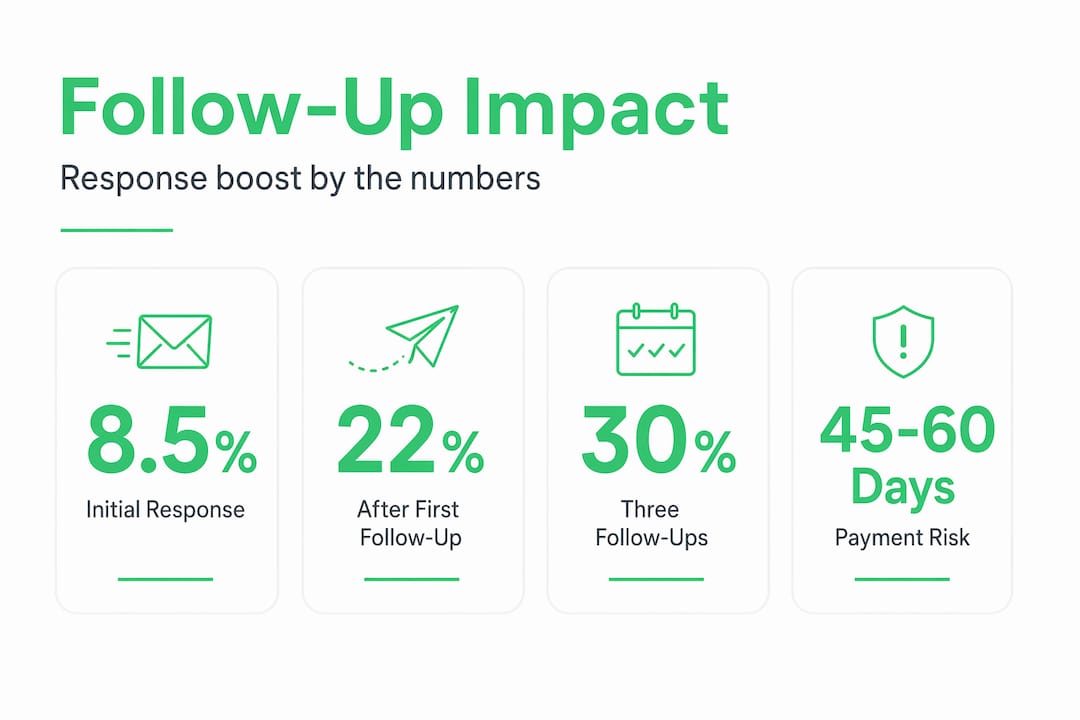
Here's the uncomfortable truth: cold email response rates sit around 8.5%. That means roughly 9 out of every 10 prospects you reach out to won't reply to your first message. Not because they hate your pitch. Often because your email arrived at the wrong moment, got buried under 40 other unread messages, or simply didn't give them a clear enough reason to act right then.
The importance of follow up emails becomes obvious when you think about how clients actually make decisions. They're busy. They're juggling vendor comparisons, internal approvals, and shifting priorities. Your proposal didn't fail. It just got lost. A follow-up email reopens that attention without requiring the client to dig through their inbox to find your original message.
Follow-ups also do something less obvious: they signal professionalism. A freelancer who follows up thoughtfully communicates that they manage their pipeline, respect their own time, and take client relationships seriously. That's a signal clients notice, even if they never say so out loud.
What follow-ups don't do is rescue bad proposals. If your initial outreach was vague, overpriced, or sent to the wrong person, a follow-up just confirms the mismatch. The benefits of follow up emails are real, but they work best when your first message was already solid.
- Follow-ups recover proposals that got buried, not rejected
- They demonstrate professional persistence without being aggressive
- They give clients a low-friction way to re-engage on their timeline
- They keep your name visible during a client's decision window
Pro Tip: Before sending a follow-up, reread your original message. If you wouldn't reply to it yourself, revise the follow-up to address whatever was unclear or missing.
What makes a follow-up email actually work
The single biggest mistake freelancers make is sending a "just checking in" email. That phrase does nothing. It adds no value, answers no question, and gives the client no reason to respond. Effective follow-ups add one new insight plus a simple, specific next step. That combination is what separates a reply from silence.
Think about what you know about that client's situation. Did you notice something on their website that your proposal addressed? Did a relevant industry trend emerge since you first reached out? Lead with that. One sentence of genuine relevance is worth more than three paragraphs of pleasantries.
Here's what strong follow-up content looks like in practice:
- For a web design proposal: "I noticed your contact form isn't mobile-optimized. That's likely costing you leads from phone users. Happy to show you a quick fix as part of the project."
- For a copywriting pitch: "I saw your competitor just launched a new blog series. There's a gap in the conversation they're not covering. I have a content angle that could work well for your brand."
- For a late invoice: "Invoice #1042 for $1,800 is due this Friday. Here's the payment link for your convenience. Let me know if you need anything adjusted."
Each of these does two things: it adds something useful, and it makes the next step easy to take. That's the formula. The tone should be calm and confident, never apologetic or desperate. You're not begging for attention. You're offering something worth their time.
Pro Tip: Write your follow-up as if you're sending it to a busy colleague, not a gatekeeper. Short, specific, and easy to act on beats long and thorough every time.
Timing and frequency: how many follow-ups to send
Timing is where most freelancers either give up too early or push too hard. Most clients don't book on the first touch, which means a single follow-up often isn't enough. But sending five emails in two weeks signals desperation and damages the relationship you're trying to build.
The data points to a clear sweet spot. Three follow-ups provide the best overall response rate, with each additional email beyond that delivering smaller gains and increasing the risk of fatigue or unsubscribes. Here's how a practical sequence looks:
| Follow-up | Timing | Purpose |
|---|---|---|
| First follow-up | 2 to 3 days after initial outreach | Gentle reminder, add one new insight |
| Second follow-up | 5 to 7 days after first follow-up | Reframe the value, offer a different angle |
| Third follow-up | 7 days after second follow-up | Final note, keep the door open gracefully |
After three follow-ups with no response, move on. That doesn't mean burning the bridge. A short "I'll leave this with you and feel free to reach out when the timing is better" closes the loop professionally and sometimes generates a reply weeks later.
Adjust your timing based on context. A client who opened your email twice but didn't reply is a warmer lead than one who never opened it. If you have visibility into engagement data, use it. A client in the middle of a product launch may need more time than one in a quieter period.
Pro Tip: Set a calendar reminder the moment you send a proposal. Don't rely on memory to follow up. Treat it like a scheduled task, not an afterthought.
How follow-ups protect your cash flow
Payment collection is where the importance of follow up emails becomes financial, not just relational. Late payments are one of the most common and most damaging problems freelancers face. The fix isn't awkward phone calls or passive waiting. It's a structured, professional reminder sequence.

Send your first payment reminder 5 to 7 days before the invoice due date, not after. This is the move most freelancers skip. A proactive reminder signals that you track your invoices closely and that payment is expected on time. It also gives clients a chance to flag any issues before the deadline passes.
| Reminder stage | Timing | Tone |
|---|---|---|
| Pre-due reminder | 5 to 7 days before due date | Friendly, informational |
| Due date reminder | On the due date | Neutral, clear |
| First overdue notice | 7 days past due | Firm, still professional |
| Second overdue notice | 14 days past due | Direct, reference consequences |
| Final notice | 30 to 45 days past due | Formal, state next steps clearly |
Frame every reminder as a standard business process, not a personal request. Include the invoice number, the amount owed, the due date, and a payment link every single time. Clients should never have to search for how to pay you. Make it one click.
If an invoice reaches 45 to 60 days overdue with no response, consider pausing work on active projects and escalating to a formal written notice. This isn't a threat. It's a professional boundary that protects your business.
Pro Tip: Always attach the original invoice to every payment reminder. Clients often claim they lost it. Remove that excuse before it becomes a delay.
Practical tips for building follow-up into your workflow
Knowing why email follow ups work is only useful if you actually do them consistently. Most freelancers intend to follow up but let it slip because there's no system. Here's how to build one without it consuming your week.
- Template but personalize. Create a base template for each follow-up type (proposal, payment, project check-in), then spend two minutes customizing the key detail for each client. Generic templates feel generic. One specific sentence changes everything.
- Use a simple pipeline tracker. A spreadsheet with columns for client name, outreach date, follow-up dates, and status is enough. You don't need expensive software to stay organized.
- Batch your follow-ups. Set aside 20 minutes on Monday and Thursday mornings to review your pipeline and send any follow-ups due that day. Batching prevents the mental overhead of constant task-switching.
- Know when to stop. Automation and pipeline quality are as important as the follow-up itself. Don't spend 45 minutes crafting a fourth follow-up to a lead who has ignored three. Redirect that energy to finding better prospects.
- Measure what works. Track which follow-up messages generate replies and which don't. Over time, you'll see patterns. Double down on what works, cut what doesn't.
Automating follow-up emails while keeping them personalized is a real option for freelancers with larger pipelines. Tools that let you schedule sequences while inserting client-specific details save time without sacrificing the personal touch that gets replies.
Pro Tip: Treat every follow-up as a second sales touch with a narrow purpose. One goal per email. If you're asking for a reply AND a referral AND a review, you'll get none of them.
My take on follow-ups after years of freelance outreach
I've seen freelancers treat follow-ups like a necessary evil, something you do reluctantly because you need the money. That framing is what makes them ineffective. When you write from a place of "I need this client to respond," that energy bleeds into the email, and clients feel it.
What changed my own approach was treating every follow-up as a small asset. I ask myself: what does this person actually need right now, and can I give them one useful thing in three sentences? When I started doing that, response rates improved noticeably. Not because I was more persistent, but because I was more useful.
I've also learned that the best follow-up strategy is a strong pipeline. If you're chasing five weak leads with aggressive follow-ups, you're spending energy in the wrong place. The freelancers I've watched succeed long-term spend more time finding better prospects through tools like local business lead generation and less time begging lukewarm leads to respond.
The other thing most freelancers get wrong is tone. Confident doesn't mean cold. You can be warm, specific, and direct all at once. Follow-ups are part of a relationship, not just a transaction. The clients who become long-term partners often remember how you handled the silence before the first project started.
— Olivine
Find better leads, follow up smarter
Effective follow-ups only move the needle when you're reaching out to the right people in the first place. That's where Useolivine changes the equation for freelancers.
Useolivine's Lead Finder tool scores local business leads based on website quality, ratings, and other key metrics so you're not wasting follow-up energy on low-potential prospects. Every lead comes with personalized outreach tools, including pre-drafted emails tailored to that business's specific needs. You can track outreach stages, generate website mockups, and manage your entire pipeline in one place. With over 20,000 indexed leads across 50+ business categories, you'll spend less time hunting and more time converting. Explore Useolivine's lead finder and start following up on leads worth winning.
FAQ
Why do follow-up emails matter for freelancers?
Follow-up emails recover proposals that got buried and keep conversations alive with clients who weren't ready to respond immediately. Since cold email response rates average around 8.5%, follow-ups are how freelancers convert the other 91.5% of missed opportunities.
How many follow-up emails should a freelancer send?
Three follow-ups deliver the best response rates, with diminishing returns beyond that point. Space them 5 to 7 days apart and use a different angle or new insight in each one.
What should a follow-up email include?
Every follow-up should add one new piece of useful information and include a clear, low-friction next step. Avoid generic phrases like "just checking in" since effective follow-ups add real value rather than just requesting attention.
When should I send a payment reminder?
Send your first payment reminder 5 to 7 days before the invoice due date, then follow up on the due date and at 7, 14, and 30 days overdue. Always include the invoice number, amount, and a direct payment link with every reminder.
How do I follow up without sounding pushy?
Keep your tone calm, specific, and professional. Lead with something useful to the client rather than focusing on your own need for a response. Persistence protects client relationships when your timing and tone are calibrated correctly.