

Most businesses have a lead problem that isn't actually a lead problem. They generate prospects, run outreach, and still watch revenue stall. The real issue is that they treat cold leads like warm ones, expecting fast closes from people who barely know them. Learning to convert cold leads paying clients requires a fundamentally different playbook: slower, more deliberate, and built around education rather than pressure. This guide walks you through the exact preparation, outreach, and measurement strategies that turn cold prospects into clients who are ready to buy.
Table of Contents
- Key takeaways
- Converting cold leads: what makes them different
- Preparation: tools and prerequisites
- Execution: step-by-step outreach techniques
- Verification: measuring and improving your conversion system
- What better conversion actually does for your business
- My take on what actually moves the needle
- Find and convert better cold leads with Useolivine
- FAQ
Key takeaways
| Point | Details |
|---|---|
| Cold leads need more touches | 79% of B2B prospects need at least 5 touchpoints before converting, so plan your sequences accordingly. |
| Speed-to-lead changes everything | Contacting a lead within 5 minutes makes you 21x more likely to qualify them than waiting 30 minutes. |
| Separate cold and nurture outreach | Mixing cold outreach with nurture sequences raises spam complaint rates by 15 to 25%, damaging your deliverability. |
| Measure at every funnel stage | Stage-level conversion analytics reveal exactly where cold leads drop off so you fix the right problem. |
| Personalization beats pitch perfection | Opening with a specific, recent signal and a low-friction question outperforms a polished sales pitch every time. |
Converting cold leads: what makes them different
Before you can reliably convert cold leads into paying clients, you need to understand why they behave so differently from warm leads. A warm lead has already expressed interest, visited your site, or heard of your brand. A cold lead has done none of those things. They have no emotional investment in what you offer, which means your first job is not to sell. It is to earn enough trust to have a real conversation.
Cold leads convert at roughly 1 to 3%, while warm leads convert at 5 to 15%. That gap exists because of context, not quality. A cold lead who gets properly nurtured can absolutely become a high-value client. The timeline just looks different.
Here is what separates cold leads from warm leads at a glance:
| Factor | Cold leads | Warm leads |
|---|---|---|
| Awareness of your brand | None or minimal | Moderate to high |
| Sales approach needed | Education first, pitch later | Solution-focused pitch |
| Typical conversion rate | 1 to 3% | 5 to 15% |
| Average touches to convert | 7 to 12 | 3 to 5 |
| Patience required | High | Moderate |
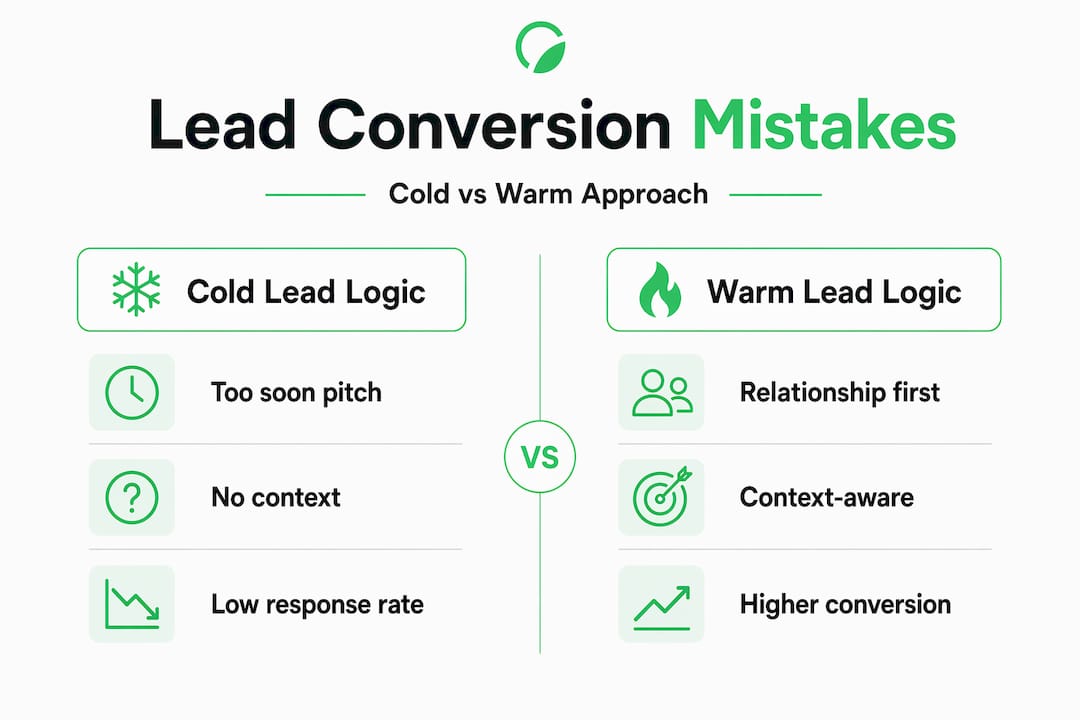
The biggest mistake sales professionals make is applying warm-lead logic to cold prospects. They send a pitch on the first email, follow up once, and give up. Cold leads require patience, a structured sequence, and consistent value delivery at every touchpoint.
Preparation: tools and prerequisites
Getting your systems ready before you touch a single cold lead is what separates teams that convert from teams that just stay busy. Here is what you need in place:
- Lead scoring and segmentation. Not all cold leads are worth the same effort. Score leads based on firmographic fit, website quality, and engagement signals before you spend time on outreach.
- A CRM with fast response capability. Automating lead data transfer into your sales workflow removes admin gaps and means your reps walk into first meetings already knowing the prospect's context.
- Personalization research. Know the prospect's industry, recent news, and any visible pain points before you write a single word of outreach.
- A defined outreach cadence. Plan for 3 to 7 touches across multiple channels before you make a judgment call on a lead's potential.
The speed-to-lead principle is non-negotiable. Contacting a lead within 5 minutes makes you approximately 100x more likely to reach them and 21x more likely to qualify them compared to waiting 30 minutes. This is not a minor efficiency gain. It is the single most impactful variable in your entire conversion system.
| Tool or requirement | Why it matters |
|---|---|
| CRM with automation | Speeds up response time and preserves lead context |
| Lead scoring model | Focuses effort on highest-potential prospects |
| Outreach templates | Maintains consistency while allowing personalization |
| Multi-channel capability | Enables email, phone, and social touchpoints in one sequence |
| Analytics dashboard | Tracks stage-level conversion and response rates |
Pro Tip: Before launching any cold outreach, build a short research checklist for each prospect: company size, recent website changes, Google rating, and any public news. This takes five minutes per lead and dramatically improves your first message's relevance.

Execution: step-by-step outreach techniques
This is where most teams either win or lose the conversion battle. The execution phase is about crafting a multi-touch, multi-channel sequence that moves cold leads toward a conversation without pushing them away.
Here is a proven step-by-step approach:
- Send a signal-based first email. Opening with a specific, recent signal and a low-friction question increases response rates far more than a polished pitch. Reference something real: a recent review, a website issue you noticed, or a gap in their online presence.
- Follow up with value, not repetition. Each follow-up should introduce new information or a new angle. Effective cold email sequences run 3 to 5 personalized messages over 2 to 3 weeks, with each message adding something the previous one did not.
- Add a phone call at touch three or four. Email alone is rarely enough. A brief, well-timed call after two emails shows you are serious and gives the prospect a different way to engage.
- Use LinkedIn for a soft touchpoint. A profile view or a thoughtful comment on their content keeps you visible without feeling aggressive.
- Include a retargeting layer if possible. If you have the prospect's domain or email, retargeting ads on social platforms create the impression of familiarity before your next email arrives.
- Close the sequence with a clear final ask. Let them know this is your last message for now. Many replies come at this stage because the prospect finally feels the urgency to respond.
- Move unresponsive leads to a long-term nurture list. Do not delete them. Revisit in 60 to 90 days with fresh context.
Optimal nurture sequences run 5 to 7 emails, and research shows 79% of B2B prospects need at least 5 touchpoints before they are ready to engage. Going shorter leaves money on the table. Going longer without new value damages your sender reputation.
Here is how two common outreach approaches compare:
| Approach | Touches | Channels | Conversion potential |
|---|---|---|---|
| Single-channel email only | 1 to 2 | Low | |
| Multi-touch, multi-channel | 5 to 7 | Email, phone, LinkedIn | High |
| Pitch-first cold email | 1 | Very low | |
| Signal-based, value-first sequence | 5 to 7 | Email, phone, social | Highest |
Pro Tip: Never mix cold outreach and nurture sequences in the same email program. Programs that mix cold and nurture see 15 to 25% higher spam complaint rates. Keep them in separate lists with separate sending domains if possible.
Verification: measuring and improving your conversion system
Running outreach without measuring it is like driving without a speedometer. You might be going the right speed, but you will not know until something goes wrong.
Start by tracking these core metrics inside your CRM:
- Stage-level conversion rates. Measuring conversion by stage reveals exactly where leads stall. If 60% of your cold leads drop off after the first email, that is a messaging problem. If they drop at the proposal stage, that is a pricing or fit problem.
- Response time by rep. Track how quickly your team follows up on new leads. Even a 10-minute delay compounds into significant revenue loss over a quarter.
- Win/loss ratio by lead source. Not all cold lead sources perform equally. Knowing which channels produce closeable leads helps you allocate effort correctly.
- Email deliverability metrics. Watch your bounce rate, spam complaint rate, and open rate. A deliverability problem quietly kills an entire outreach program.
"Improving conversion depends heavily on marketing and sales alignment, not just more outreach. Standardized qualification criteria and shared funnel definitions reduce stalls and make conversion predictable."
When you find a bottleneck, diagnose before you change everything. If cold leads are not responding to your first email, test a different signal or subject line before overhauling your entire sequence. Targeted fixes outperform broad overhauls every time.
Median website conversion sits at 2.35%, but the top 10% of conversion systems achieve 11.45%. That gap is not luck. It is the result of consistent measurement, testing, and refinement applied over months.
Pro Tip: Focus your optimization energy on responses and meetings booked, not open rates. Open rates are a vanity metric. A 15% open rate that books zero meetings is worse than a 10% open rate that books five.
What better conversion actually does for your business
The compounding effect of improving your cold lead conversion rate is significant and often underestimated. A 2% improvement in conversion rate across 500 monthly cold leads means 10 additional clients per month. At an average client value of $2,000, that is $20,000 in additional monthly revenue from the same lead volume.
Beyond the math, here is what a systematic cold lead conversion process delivers over time:
- Shorter sales cycles. When leads are properly nurtured and educated before a sales call, meetings become decisions rather than discovery sessions.
- Higher average deal value. Educated prospects understand your value and push back less on price.
- Predictable pipeline. A repeatable process means you can forecast revenue with confidence instead of hoping this month's batch converts.
- Lower cost per acquisition. Getting more clients from the same lead pool reduces your effective cost per client without increasing your ad spend.
The businesses that scale their cold outreach successfully are not the ones with the best pitch. They are the ones with the most disciplined process, the fastest response times, and the clearest measurement systems.
My take on what actually moves the needle
I've seen agencies and freelancers spend months perfecting their email copy while ignoring the two things that actually determine whether a cold lead converts: how fast they respond and whether their sales and marketing teams agree on what a qualified lead even looks like.
In my experience, the pitch is almost never the problem. I've watched teams with mediocre copy outperform polished competitors simply because they responded to new leads in under five minutes and had a clear, shared definition of what "ready to buy" meant. The teams that struggled were the ones where marketing handed off a lead and sales had no context, no history, and no agreed-upon next step.
The hardest lesson I've learned is that cold lead conversion is a system problem, not a talent problem. When a sequence stops working, the instinct is to hire a better copywriter or try a new channel. But usually the fix is simpler: check your stage-level data, find where leads are dropping, and make one targeted change. What I've found actually works is boring by most standards. It is consistent follow-up, honest personalization, and a willingness to measure what matters rather than what feels good to report.
— Olivine
Find and convert better cold leads with Useolivine
If you are spending time on cold outreach but struggling to find high-quality prospects to contact in the first place, the problem starts before your first email.
Useolivine's Lead Finder tool scores prospects based on website quality, ratings, and key business metrics so you spend your outreach budget on leads that are actually worth pursuing. You can search across more than 50 business categories, get personalized email drafts tailored to each prospect's specific situation, and track every stage of your outreach pipeline in one place. Useolivine even generates customized website mockups for each lead, giving you a concrete conversation starter that cold email alone cannot match. If you are serious about turning cold prospects into paying clients, explore what Useolivine offers and see how better lead sourcing changes your conversion math.
FAQ
What is a realistic cold lead conversion rate?
Cold leads typically convert at 1 to 3%, compared to 5 to 15% for warm leads. With a structured, multi-touch outreach sequence, you can push cold lead conversion rates toward the higher end of that range over time.
How many follow-ups does it take to convert a cold lead?
Research shows 79% of B2B prospects need at least 5 touchpoints before they engage. Plan for a sequence of 5 to 7 messages across multiple channels before drawing conclusions about a lead's potential.
How fast should I respond to a new cold lead?
Speed matters more than most teams realize. Responding within 5 minutes makes you 21x more likely to qualify a lead than waiting 30 minutes. Set up CRM automation to alert your team the moment a new lead enters your pipeline.
Why are my cold emails going to spam?
The most common cause is mixing cold outreach and nurture sequences in the same email program. Programs that combine cold and nurture see 15 to 25% higher spam complaint rates. Keep them in separate lists and, where possible, use separate sending domains.
What is the most important metric to track in cold lead conversion?
Stage-level conversion rates inside your CRM give you the clearest picture of where leads stall. Tracking conversion by opportunity stage lets you make targeted fixes instead of overhauling your entire process based on a hunch.